
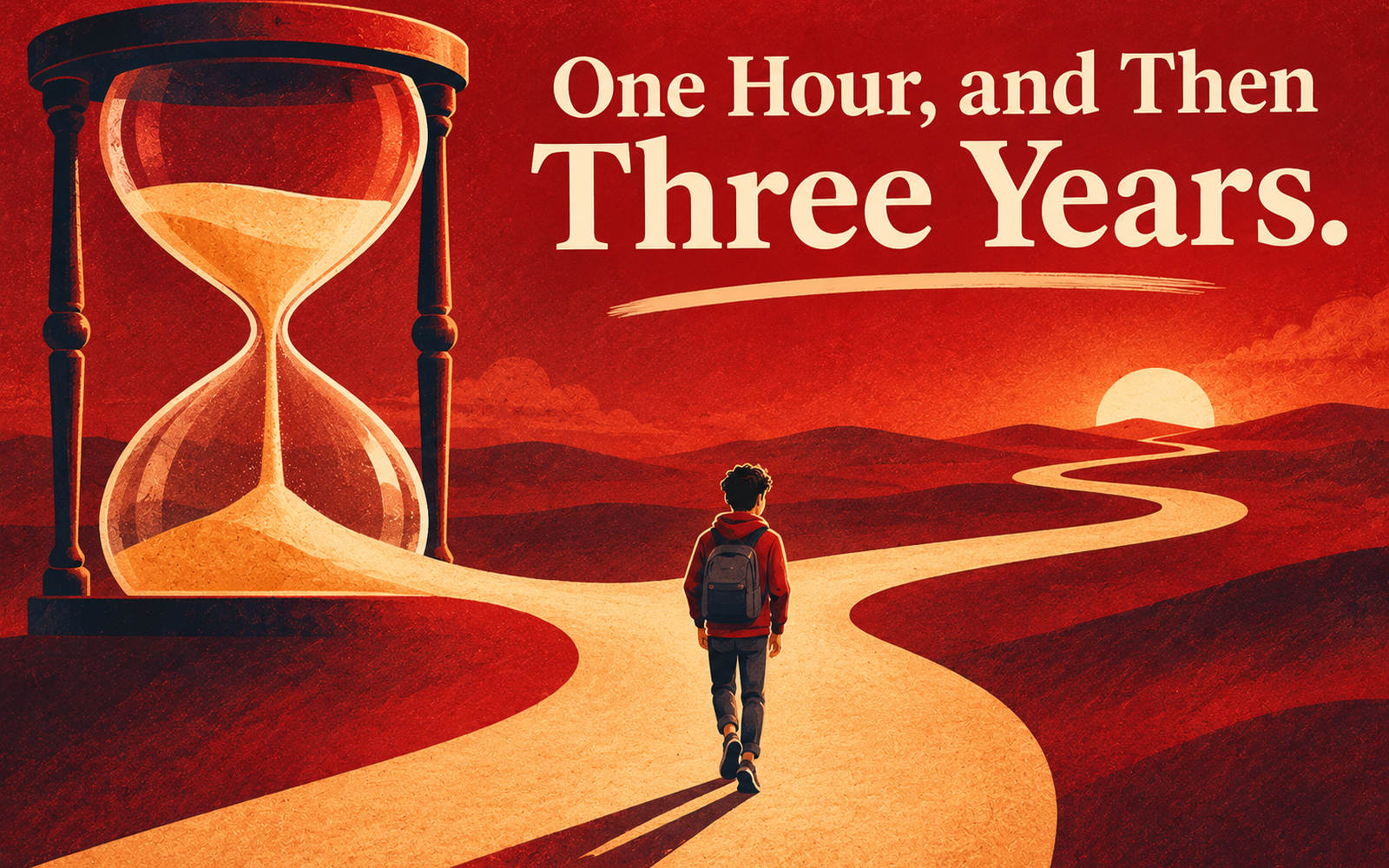
The least believable finding in modern psychology is also one of the most replicated, and the reason people struggle with it says more about how we think about change than about the research.
In 2011, Gregory Walton and Geoffrey Cohen published a study in Science. First-year college students did a brief writing exercise, roughly an hour, in which they encountered evidence that the difficulties of starting college are common, temporary and shared rather than personal and permanent. Then they wrote about it themselves, ostensibly to help future students.
That was the intervention. One hour. No tutoring, no funding, no curriculum change, no additional staff.
Over the following years the grade gap between Black and White students in that cohort narrowed. Not in the following week. Over years. A later replication with colleagues, published in Science Advances in 2020, reported durable effects for Black American students.
Walton is now a professor of psychology at Stanford, and his 2025 book Ordinary Magic is the trade-length account of two decades of work in this vein. He calls them wise interventions, and he co-edited the field's handbook with Alia Crum in 2020. The word wise is doing specific work in that phrase. It does not mean clever. It means precisely targeted at a particular interpretation at a particular moment.
Here is the mechanism, because without it the finding sounds like magic and invites the reasonable suspicion that it is.
A student arrives somewhere new and something goes badly. A seminar where she says nothing. A piece of work returned with more criticism than she expected. An invitation that does not come. Every one of those events is ambiguous: it has an ordinary explanation and a catastrophic one. The ordinary explanation is that starting is hard for everybody. The catastrophic one is that it confirms she does not belong here.
Walton's term for that fork is belonging uncertainty, and the crucial observation is that the two readings produce completely different next weeks. The student who reads it as ordinary tries again. The student who reads it as confirmation starts protecting herself, which means contributing less, asking for less, and showing less. And because she shows less, the next ambiguous event arrives with more evidence behind it.
That is a spiral, and it is self-funding. Which is exactly why one hour can matter so much. You are not adding a resource. You are intervening on an interpretation at the moment it is being formed, before it has compounded.
This is the fourth book in The Unmistakably You Series, Stop Suppressing, Start Unleashing, and Walton's data is the most direct evidence I know of for its central claim. The teenager who has gone quiet is not short of ability and usually not short of support. She is running an interpretation, and the quiet is the behavior that interpretation recommends. Change the interpretation and what gets unleashed was there the whole time, which is why the effects look impossibly large relative to the input. The input was never supposed to supply the capability.
Now the honest part, which belongs in the piece rather than a footnote.
These interventions are not a dose you can administer to anyone, anywhere, and expect a result. The effects are heterogeneous: they tend to show up for students who are actually facing belonging uncertainty, and to do little for students who are not, which means an average effect across a whole population can look unimpressive while concealing a large effect in the group that needed it. They are sensitive to timing, to who delivers them and to whether the environment makes the new interpretation plausible. Tell a student that difficulty is temporary and shared, in a setting that then treats her as though it is neither, and you have not helped her; you have taught her that adults say things. The last decade of this literature has included real argument about replication and scale, and the honest summary is that the mechanism is solid and the engineering is hard.
So the lesson for anyone building something for adolescents is narrower and more demanding than "small things work."
It is that the leverage sits on interpretation rather than circumstance, that it is time-sensitive, and that it is wasted unless the surrounding environment can bear out what you have just told the young person. The hour is cheap. Making the hour true is the actual work.
Which reframes what a parent or a school is really doing in the ordinary moments. You are not usually adding anything. You are arriving at a fork, a few seconds wide, where an ambiguous event is about to be filed as either ordinary or permanent, and you have some say in which.
One hour was never the point. The three years were.
Want to explore these ideas further? Learn more about my work on leadership, identity and conviction at www.theglennllopis.com.
This essay was first published on Conviction Chronicles