
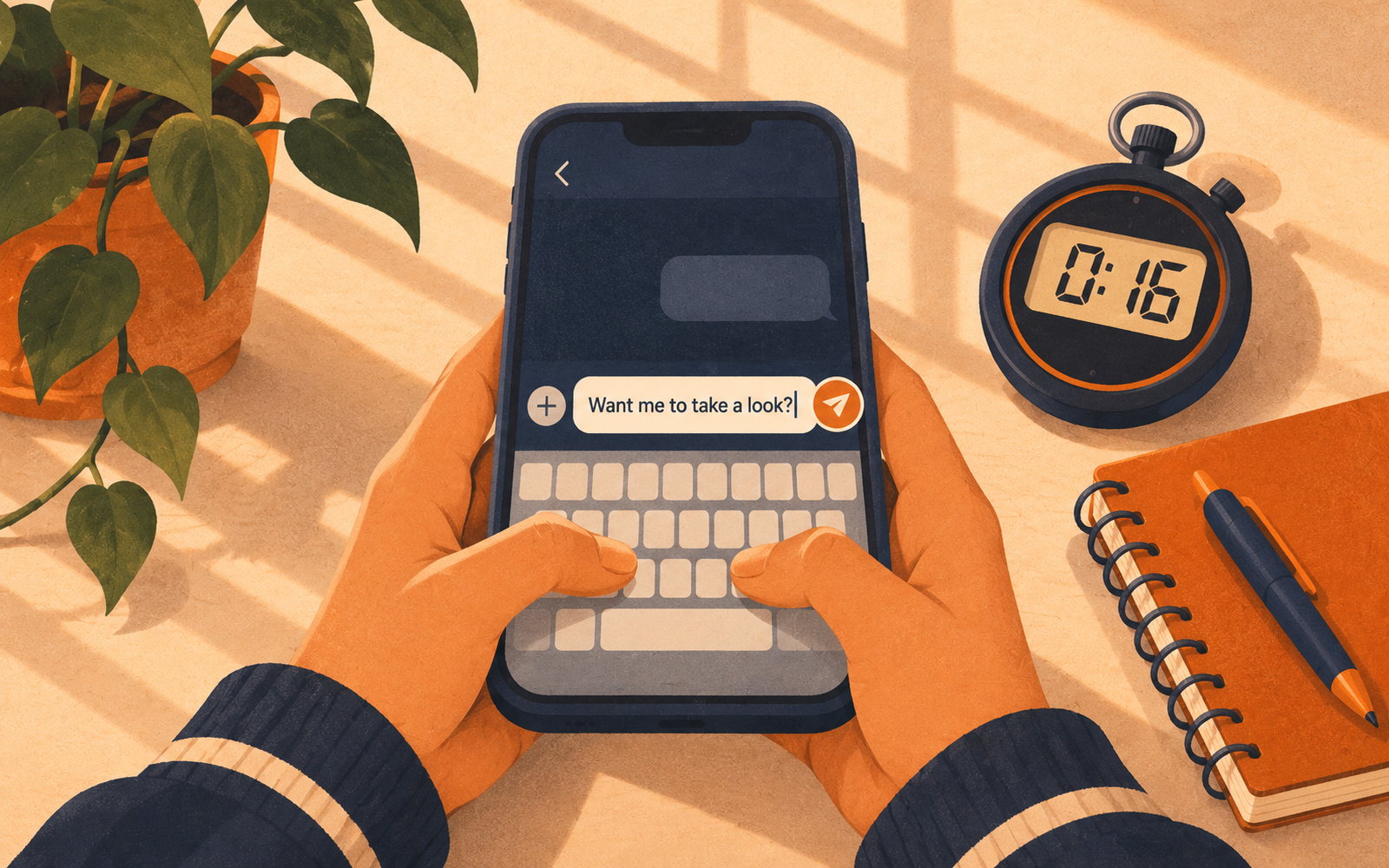
Here is a message that takes about sixteen seconds to write:
“Hey, I heard you’re having trouble with the sign-ups for Saturday. I’m decent at spreadsheets. Want me to take a look?”
That’s it. That’s the whole move.
Ask almost any adult how they got their first real break, and if they’re honest, it sounds a lot like that message. Somebody had a problem. They said, I can do that. They weren’t the best person in the world for it. They were the one who offered, and then they followed through.
From the outside, it looked like luck. It wasn’t. It was sixteen seconds and a yes.
So why don’t more people send the message? Three reasons, and you’ve probably felt all of them.
You think you’re not good enough yet. You don’t have to be the best. You have to be useful and willing. “I’m decent at this and I’ll try” beats “I’m great at this” from someone who never offers.
You think you’ll be bothering them. This one is almost always wrong. Psychologists Nicholas Epley, Xuan Zhao and Amit Kumar have found the same thing again and again: we badly underestimate how glad other people are to get an offer of help, and how good a small kindness feels on the receiving end. The awkwardness is mostly on your side of the screen.
You think someone else will do it. They won’t. Everyone is thinking the same thing, which is exactly why the opening is still open.
Lucky Isn’t Random, the first book in The Unmistakably You Series, is about this. Openings are everywhere, and most of them sound like someone complaining. “Nobody ever updates the team page.” “I can never find anyone to help set up.” “I wish somebody would just organize this.” Those aren’t complaints. Those are invitations with no name on them yet.
Your sixteen seconds
Listen for one complaint this week. At school, at home, on the team, at work.
Ask yourself: is there any piece of that I could help with? It can be small. Small is better.
Send the message. Say what you heard, what you can do, and ask if they’d like the help.
If they say yes, do it fast. Within three days. Speed is what makes people remember you.
Most of the time you’ll get a yes. Sometimes you’ll get a “no thanks,” and that’s fine. You’ve lost sixteen seconds and they now know you’re someone who offers.
Do it a few times and something changes. People start coming to you. That’s when it stops looking like luck to you, too.
Want to explore these ideas further? Learn more about my work on leadership, identity and conviction at www.theglennllopis.com.
This essay was first published on Conviction Chronicles