Every educator has watched this happen. An adult stands in front of a room of fifteen-year-olds and delivers a careful, well-meant lesson about making good choices. The students are polite. Some take notes. Nothing changes.
Then an older student says roughly the same thing in the hallway, in half the words, and it lands.
We tend to treat this as a mystery, or as proof that teenagers don’t listen. It is neither. It is one of the better-documented facts about adolescence.
In 2018, researchers David Yeager, Ronald Dahl and Carol Dweck reviewed why programs designed to change teenagers’ behavior so often fail. Their conclusion was direct. Traditional programs are not always effective for adolescents and can even backfire. The ones that work are built around something teenagers feel far more sharply than younger children do: whether they are being treated with respect, and whether they are seen as someone with standing. A lesson that feels like an adult telling them how to live runs straight into that. The content may be right. The delivery tells them they are being managed.
This shaped a decision we made in building the online training for the Unmistakably You books. The first draft was teacher-led. An educator on our team read it and said it would not work that way. It needed to come from someone who looks and sounds like a peer, and it needed to be shorter. We rebuilt it as peer-led and interactive, and cut it nearly in half.
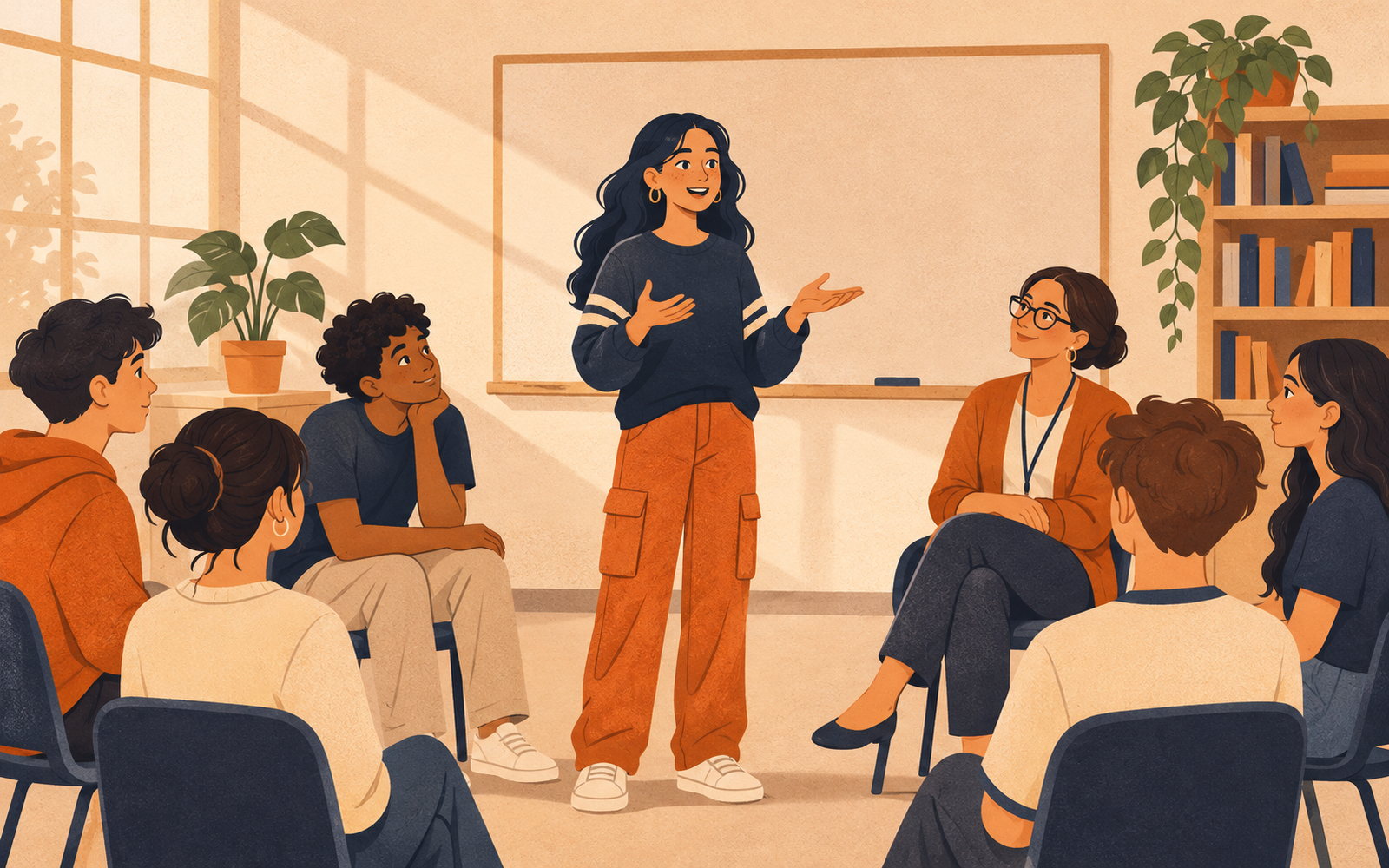
The same thinking runs through the classroom curriculum. The design is student-led and teacher-facilitated. Students read, question the text, work through realistic scenarios, go and try something, then come back and report what happened. The teacher’s job changes from delivering answers to making the room safe enough for honest ones.
That last part matters as much as who is talking. Peer-led does not mean adult-free. It means the adult holds the structure and the trust, and lets the insight come from the students.
If you want to try this in your own room
Let a student open. Ask one to share a real moment, in their own words, before you say anything about the topic.
Ask more than you tell. A question a student has to answer does more than a point you make well.
Use older students. A junior explaining what they wish they had known as a freshman has a kind of authority you cannot borrow.
Give real choices. Even small ones: which scenario to work on, whether to share out loud or on paper.
Say the purpose plainly. Respect includes telling students why you are asking them to do something.
Never require anyone to share something personal. Trust is built by leaving that door open, not by pushing students through it.
Teenagers are not resistant to learning. They are resistant to being talked down to. Change who is speaking, and how, and the same lesson gets a different hearing.
Want to explore these ideas further? Learn more about my work on leadership, identity and conviction at www.theglennllopis.com.
This essay was first published on Conviction Chronicles