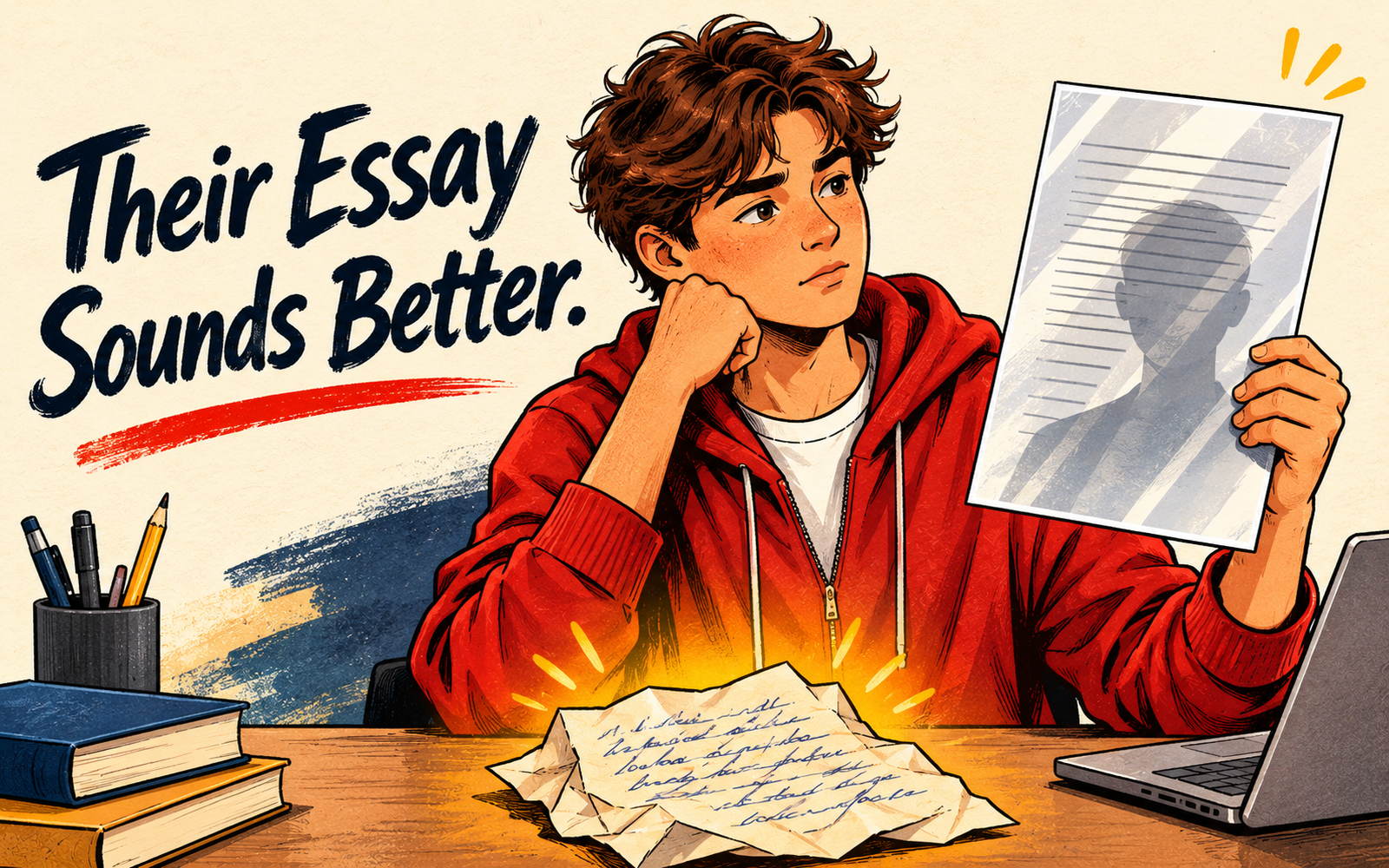
This is the season when college essays get read at kitchen tables. A senior hands over a draft. A parent reads it, maybe twice, and then has a strange feeling that is hard to put into words. The essay is good. The sentences are smooth. It just doesn't sound like the kid who wrote it.
New research suggests that feeling deserves attention.
Richer Words, Narrower Ideas
A team of researchers led by Kibum Moon and Adam Green at Georgetown University studied college admissions personal statements from 372,793 applicants, comparing essays written before ChatGPT was released in late 2022 with essays written after. What they found is subtle and, for anyone who cares about how young people think, unsettling.
After ChatGPT arrived, the vocabulary in the essays became more varied. The ideas became more alike, both within individual essays and across the whole pool. The team also ran controlled experiments, and those point to AI as the cause of the pattern. Then came the twist. When raters judged the essays, they rated the post-ChatGPT essays as more creative. The richer wording made the essays look original even as the thinking underneath converged.
A fair caution: this paper is a preprint, meaning it has been shared publicly but has not yet completed peer review. But it builds on earlier work from the same group that has. In a study published in Computers in Human Behavior: Artificial Humans, Moon, Green and Kostadin Kushlev compared real college admissions essays with essays GPT-4 wrote to the same prompts. Taken together, the students' essays contributed two to eight times more distinct ideas than the AI's, even when the AI was pushed to be more creative.
Rebecca Winthrop of the Brookings Institution brought this research to a wide audience in The New York Times this spring, and I am glad she did. Every parent of a junior or senior should know it exists.
The One Essay That Is Supposed to Be Them
There is a painful irony here. The personal statement is the one place in the whole application where a student is asked, directly, who they are. Grades, scores and activity lists show what a student has done. The essay is meant to show how they think and what they notice that someone else would miss.
That is exactly the part that AI flattens. It can make any story sound polished. What it cannot supply is the specific, slightly odd detail that only one person would think to include: the conversation with a grandmother at a bus stop, the summer job that changed how they see their town, the question they could not stop asking in ninth grade.
The Georgetown team found one more thing worth naming carefully. The narrowing of ideas was strongest among applicants from minoritized groups. Those are often the students whose stories are least like anyone else's, and therefore the ones with the most to lose when an essay starts to sound like everyone's.
For years I have argued that when everyone has access to the same tools and the same playbook, the only advantage left is what is original to you. College admissions may be the clearest test of that idea any teenager will face.
Helping Your Senior Keep Their Voice
Start with a story only they can tell. Before anyone writes a word, ask your teen for a moment no other applicant could have lived. If the opening could belong to anyone, it is not the right opening yet.
Get the first draft out of their head, not a screen. A voice memo on a walk or a messy handwritten page often captures how a teenager actually talks better than a polished draft does.
Read it out loud together. Ask one question: does this sound like you? If they hesitate, find the sentences that don't, and ask what they would say instead.
Use tools for feedback, not for ideas. If your teen uses AI at all, it should come after the draft exists, to catch errors or tighten a paragraph. The ideas need to be theirs before anything else touches them.
Resist the urge to polish it yourself. Parents can flatten an essay too. A slightly rough sentence in your teen's real voice is worth more than a perfect one in yours.
Counselors, ask what they left out. Often the best material is the detail a student cut because it felt too ordinary. It is usually the most original thing in the draft.
Admissions readers see thousands of essays that sound impressive. The ones they remember sound like a person.
The best essay your teen can write is the one no one else could have written.
Want to explore these ideas further? Learn more about my work on leadership, identity and conviction at www.theglennllopis.com.
This essay was first published on Conviction Chronicles