
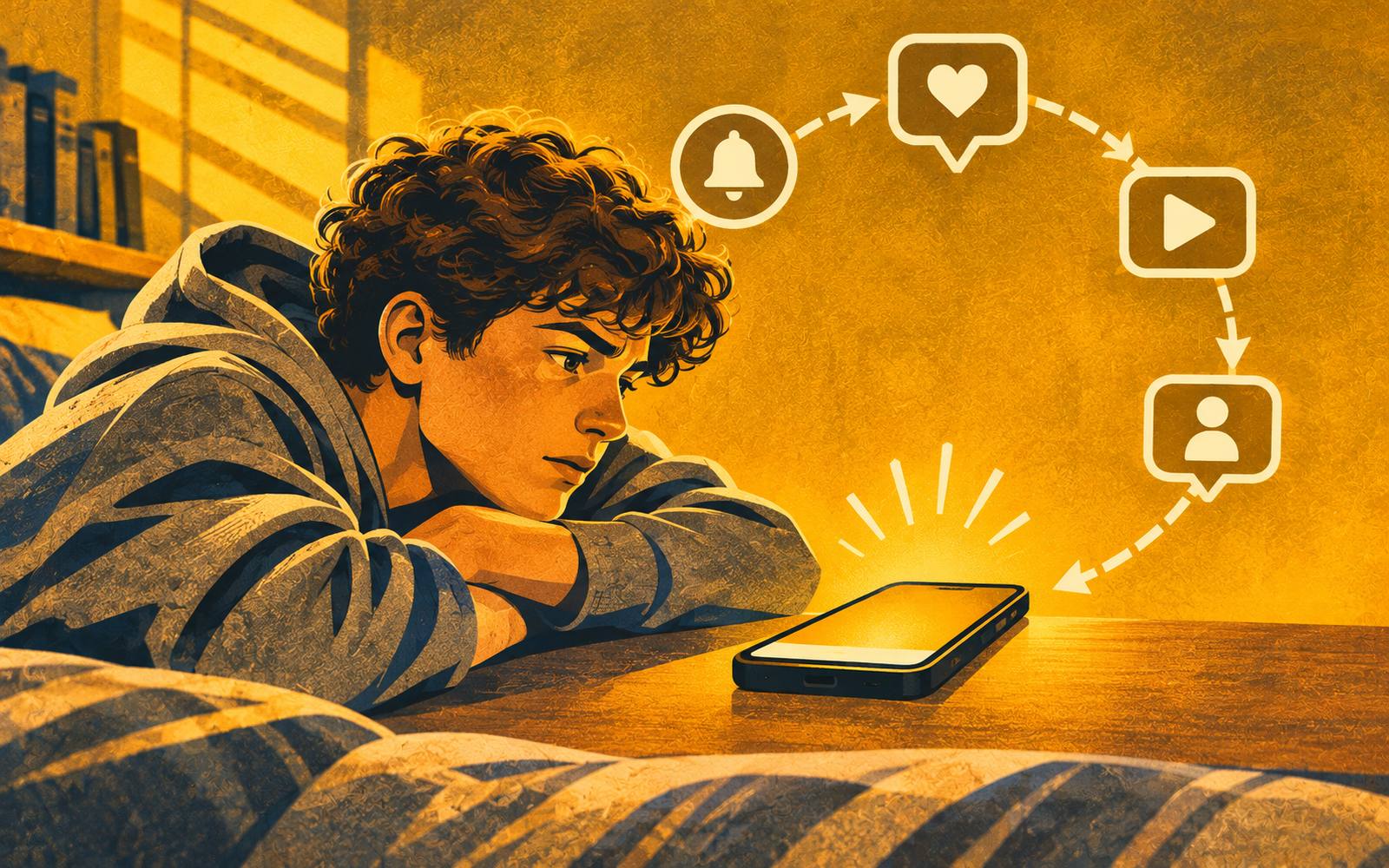
Your hand got there before you did. You were not bored and you had not decided anything. The phone was just in your hand, and you were looking, and you could not have told anyone what you were looking for.
That is not weakness and it is not a lack of discipline. It is a prediction. Something in you has learned to expect that checking is about to pay off, and it is placing the bet without asking you first.
Eva Telzer studies exactly that, and she studies it in a way almost nobody can, because it takes years.
She is a professor of psychology and neuroscience at the University of North Carolina at Chapel Hill and co-directs the Winston Center on Technology and Brain Development. In 2023 her lab published a study in JAMA Pediatrics, led by Maria Maza, that did something unusual. They took sixth and seventh graders, found out how often they actually checked social media, and then scanned their brains repeatedly across three years while they were developing.
So not a snapshot. A trajectory.
What they found is that the twelve year olds who checked most often developed differently from the ones who checked rarely. Specifically, their sensitivity to anticipated feedback from other people followed a different path. Not their response to being liked. Their response to the possibility of being judged, before anything had happened.
Read that twice, because the word doing the work is anticipated. The thing that changed was not how good praise feels. It was how loudly the question "what are they about to think" plays when nothing has happened yet.
And now the part I will not overstate, because she does not. The study found a difference in how a trajectory ran. It did not find damage. It did not show that those twelve year olds were harmed, it did not show the difference is permanent, and Telzer is notably careful about this: she reports what the brains did and declines to claim that social media causes harm. She has pushed back on the people who say phones are destroying your generation and on the people who say nothing is happening at all. If you want one researcher in this argument who is not selling you a position, it is her.
So what is the honest takeaway?
That the expectation is trainable. If checking a lot at twelve shifted how much your brain anticipates other people's judgment, then that anticipation is not a fixed feature of who you are. It was built by repetition, in a window when you were doing a lot of building.
There is a second finding from her lab that makes this less bleak than it probably sounds. Sensitivity to what other people think is not a defect being installed in you. The same neural sensitivity to peer feedback that predicts risk-taking also predicts generosity, and in her lab's work it predicts both. The machinery that makes you care what the room thinks is the same machinery that makes you notice when someone in it is struggling. It is not an off switch you want. It is a dial, and right now yours has had a lot of practice pointing in one direction.
Which matters for the fifth book in The Unmistakably You Series, Glow Up. For Real., more than any statistic about screens. The reason performing feels automatic is not that you are fake. It is that you have run thousands of reps of checking what other people think, and your brain got good at the thing you practiced. Automatic is not the same as true.
Notice the prediction before you argue with it. You cannot stop the reach. You can catch it one second later and name it: that was a prediction, not a decision. Naming it does almost nothing on day one and a surprising amount by week three.
Count the anticipating, not the minutes. Hours are the wrong measure, and the adults arguing about them are mostly arguing about the wrong thing. The real question is how much of your day is spent pre-guessing what people will think of something you have not even done yet. That is the load.
Practice something with no feedback channel. Anything where nobody can respond. A sketchbook nobody sees, a run with no app, a conversation with one person in a room. You are not being virtuous. You are running reps on the other system, the one that notices what you think, which has had far less practice.
Stop reading automatic as identity. This is the one to take with you. If you decide at fifteen that you are a person who needs other people's approval, you will organize a life around that. The evidence says you are a person who practiced anticipating it a lot, early, by accident, during the years your brain was most willing to learn whatever it was given.
Your rep this week: once a day, when your hand gets there before you do, put the phone down without looking and say in your head, out of habit not need. That is all. You are not quitting anything. You are proving to yourself that the prediction can be wrong.
Your hand got there before you did. That is three years of practice, not a verdict on you, and practice runs both directions.
Want to explore these ideas further? Learn more about my work on leadership, identity and conviction at www.theglennllopis.com.
This essay was first published on Conviction Chronicles